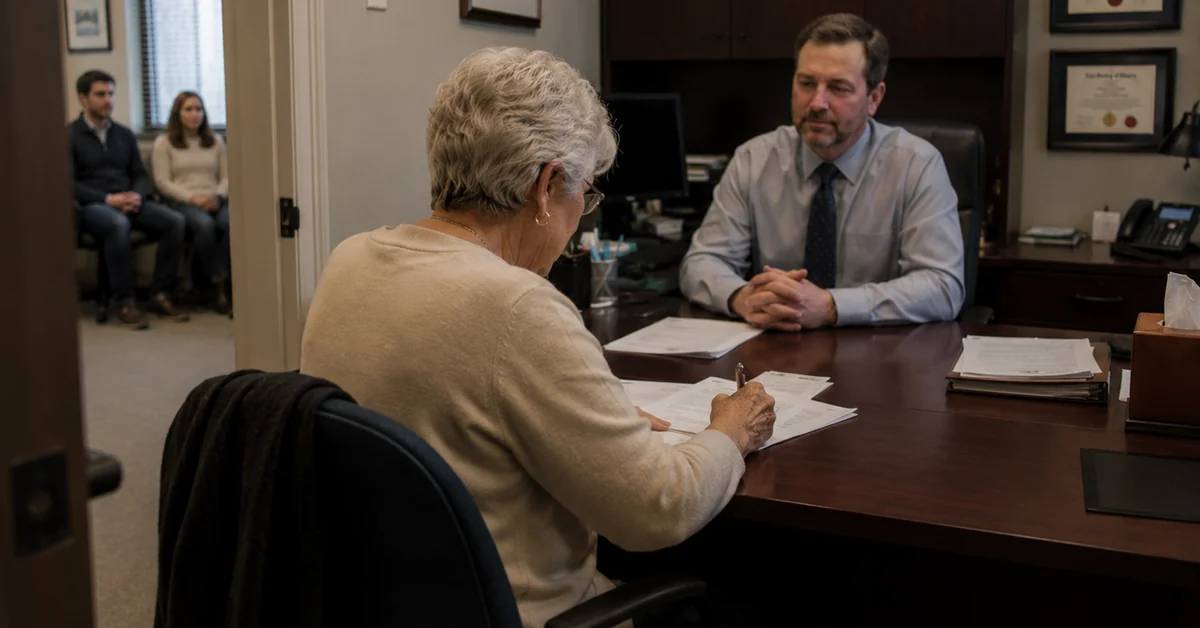
Here's a scene that plays out almost every week at my office. A single client arrives to make a will. Their adult son or daughter is with them, ready to come into the meeting.
I greet everyone in the lobby. Then I ask the family to take a seat in our waiting area. Or, if they have errands to do I suggest they might do so now, or else wait in their vehicle in the parking lot. Then I bring the client into my office alone.
Some families understand right away. Some are surprised or confused. Some are quietly hurt.
The first thing to know is that this is extremely important for their parent's and their family's protection. This is why The Law Society of Ontario, which regulates every lawyer in this province, requires it, and rightly so.
In fact, the Law Society has advised us that a child, or anyone named in your will as a beneficiary, or in your powers of attorney, should not even drive you to the appointment. Ideally, you should attend the office on your own or through separate private transportation (bus, taxi, friend).
In brief: our professional rules do not let me take instructions for a will or a power of attorney with a third party in the room, even if it's your own children. The only exception are if married spouses are making mutual Wills and Powers of Attorney.
The reasons behind that rule are not arbitrary.
The three reasons behind the rule
Picture your children in the room with us. You are giving me instructions for your will or power of attorney. Three things happened.
First, your conversation with me stops being private. Privilege protects what is said when the conversation is between you and your lawyer.
Second, the document becomes vulnerable to a future challenge. Courts in Ontario will look at who was in the room when a will was made. A beneficiary at the table can be a sign of undue influence.
Third, I cannot reliably assess your capacity. If your daughter is finishing your sentences for you, I cannot tell whether the instructions are coming from you or from her.
Each of those reasons matters. Let me unpack them.
Reason one: solicitor-client privilege
Solicitor-client privilege protects what you tell me. Generally I cannot be compelled to repeat it later, even in court unless it meets a special exemption recognized by the courts and it is rare.
That protection makes our conversation honest. You can tell me which child you trust to be the executor and which one you do not. You can tell me about a second family, or a child who has been disinherited, or money that should not be discussed at the supper table.
The moment a third party joins the room, that protection weakens. If your son is sitting beside you, his presence makes it a three-way conversation. The privilege either narrows or risks being waived altogether.
Privilege is one of your most powerful legal protections. I am not willing to let it leak by accident.
Thinking about your will or estate plan?
Wills and powers of attorney are prepared on a flat fee, quoted upfront. Typically, we pick up the phone. Rated 5.0 on Google.
Reason two: undue influence
Undue influence is the legal name for the worst-case scenario in estate planning. It is when the wishes on a will reflect pressure from a beneficiary, not the free choice of the testator.
Wills challenged on undue influence are some of the most painful cases I see. They tear families apart. The signs courts look for include:
- A beneficiary present at the will appointment.
- A beneficiary giving instructions to the lawyer or driving the appointment.
- A change in the will that benefits one child sharply over the others, made when that child was the closest helper.
I cannot stop a future challenge to the will from happening. What I can do is make sure the file shows the will was made by you, alone, with no one else in the room. My notes, our drafting record, and the absence of family at the substantive meeting all become evidence later if needed.
That same logic applies to powers of attorney. A power of attorney is a powerful document. Disputes about pressure from the named attorney do happen. The file should show the named attorney was nowhere near the room when the document was discussed.
Reason three: testamentary capacity
For your will to be valid, you must have what Ontario law calls testamentary capacity. In plain language, that means you must understand four things at the time you give your instructions:
- That you are making a will, and what a will does.
- Roughly what you own.
- Who would normally expect to inherit from you.
- That no mental disorder is affecting how you decide.
For a power of attorney for property, the test is similar but slightly different. You must understand what your attorney can do with your property, and what the consequences of giving that power look like.
I assess capacity in real time, while you talk with me. I listen to how you describe your assets. I watch how you think through choices. I ask follow-up questions. I take notes.
Picture your son or daughter in the chair beside you. He or she gently corrects your numbers. He or she prompts you with the names of your grandchildren. He or she supplies the answer when you pause. I cannot do my job in that room. The instructions on the page may not be yours.
This is not a comment on your capacity. The same is true for the most lucid eighty year old in the Kawarthas. When two people are talking, I cannot tell who is driving the answers.
What about the signing day?
There is a second meeting where family also cannot be in the room: the day you sign.
Ontario's Succession Law Reform Act has a quiet trap built into it. A gift in your will to a person who acts as a witness, or to that witness's spouse, is automatically void. The will itself stays valid, but the gift to the beneficiary-witness disappears.
In other words: if your son witnesses your will, and your will leaves him your house, he loses the house. The will still works for everyone else, but his gift is gone. Most people learn this rule too late.
The Substitute Decisions Act has a similar list of people who cannot witness a power of attorney. It includes the named attorney, the attorney's spouse, the grantor's spouse, the grantor's children, and a few others.
Because of these rules, our office uses staff as witnesses. It removes any risk of the wrong person signing in the wrong spot. Family can be in the lobby. They are not in the signing room.
What your family can do
After our private meeting I may allow them to come in to the meeting to fill in some missing information (ie. middle names, addresses). However, there are several useful things they can do prior to and after the appointment to assist you, including:
- Gather old life insurance policies, deed copies, or Bank or Investment statements. Pass the information along to you so you can bring it to me.
A note for the adult children
If you are the son or daughter who has been politely asked to wait in our lobby or in your vehicle, please do not take it personally. Almost every client I see has a loving family, and almost every family member I meet is well-meaning.
The rule is about the document, not about you. The cleaner the file, the safer your parent's wishes are. The cleaner the file, the harder it is for anyone to challenge the will later. In a round about way, the rule protects you, too.
If your parents want to share the contents of their will with you, that is their choice. They can do it any time, on their schedule. That is what privacy looks like in our office.
A note for the parent
You do not have to choose between including your family in your life and keeping your will private. The two are not the same thing.
In our office, you give your instructions alone. You sign the document with our staff as witnesses. Then, if you choose, you can tell your family whatever you want them to know.
Some clients share everything. Some share nothing. Some leave a sealed letter to be opened later. All of those are normal, and all of them are your choice.
What I will not do is let the room be crowded when the choices are being made.
The short version
The Law Society of Ontario requires lawyers to take instructions for a will or power of attorney with no third party in the room. Three reasons sit behind that rule:
- Privacy. Privilege only protects a conversation between you and your lawyer.
- Capacity. I have to be sure the instructions are yours.
- Future challenges. Courts will look at who was in the room.
Family also cannot witness the signing. The beneficiary-witness rule in Ontario's Succession Law Reform Act prevents it. The Substitute Decisions Act has similar restrictions for powers of attorney.
If you are thinking about making a will or a power of attorney, I am happy to walk through what your appointment will look like. Book a consultation, and we can plan the day together so your family knows what to expect.
Barry W. Bussey, Ph.D. (Leiden), has practised law for over 30 years. During that time, he served for ten years as Director of Legal Affairs for a national charity-sector association, appeared at every level of the judiciary, including five times before the Supreme Court of Canada, and taught as an adjunct law professor. He practises real estate, wills and estates, charity, and non-profit law in Peterborough with Bussey Ainsworth.
This article is for general information only and does not constitute legal advice. Every situation is unique. Please consult with a lawyer before making decisions about your will, power of attorney, or estate plan.